Top Aluminum Components Casting Techniques for Global Buyers?
In today’s competitive manufacturing landscape, the demand for high-quality aluminum components is soaring. Global buyers seek innovative solutions to meet their needs. Aluminum Components Casting has become a cornerstone of modern industry. This technique offers versatility, precision, and cost-efficiency in producing complex parts.
Various casting methods are employed worldwide, each with unique benefits. Some techniques ensure excellent surface finish, while others focus on strength and durability. However, choosing the right casting method requires careful analysis. Not all techniques may suit every application, leading to potential challenges.
Understanding the nuances of aluminum components casting can enhance production outcomes. By recognizing the strengths and weaknesses of each technique, buyers can make informed decisions. This knowledge fosters reliability and trust in suppliers. Navigating the casting landscape can be complex, but it is essential for long-term success. Optimal choices will lead to better designs and increased efficiency.
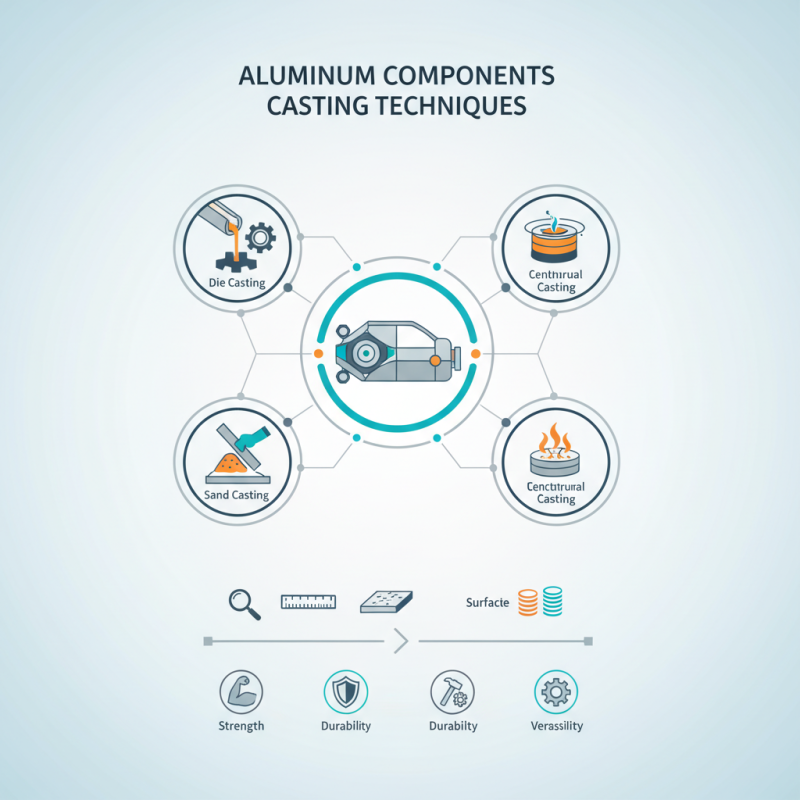
Overview of Aluminum Casting Techniques in the Global Market
Aluminum casting techniques have gained significant traction globally. Various methods cater to diverse industries. These techniques include sand casting, die casting, and permanent mold casting. Each has unique benefits and challenges. Understanding these intricacies can help buyers make informed decisions.
Sand casting remains popular due to its versatility. It allows for complex designs and various sizes. However, it can lead to surface imperfections, which may require additional finishing. Die casting excels in producing high-volume parts with excellent surface quality. Yet, it demands high initial costs for mold creation, posing a barrier for small projects.
Permanent mold casting offers a balanced approach, combining durability and precision. It often results in better mechanical properties compared to sand casting. However, the lifespan of molds may limit production runs. Each method has its trade-offs, highlighting the importance of careful analysis in choosing the right technique.
Top Aluminum Components Casting Techniques
This chart illustrates the percentage distribution of various aluminum casting techniques commonly used in the global market. The data reflects industry practices and preferences among manufacturers.
Key Factors Influencing Aluminum Component Selection for Buyers
When selecting aluminum components, buyers face various challenges. Understanding the properties of aluminum is crucial. It's lightweight, corrosion-resistant, and malleable. However, not all aluminum alloys are the same. Different applications require distinct grades.
Cost is a significant factor in material selection. Aluminum can be expensive compared to alternatives like steel. Buyers need to balance cost with performance. Understanding the performance requirements helps in making informed decisions. While some projects demand high strength, others may prioritize conductivity or weight.
Quality assurance also plays a vital role. It's essential to evaluate suppliers' certifications and production processes. Faulty components can lead to project failures. The need for reliable sourcing cannot be overstated. As buyers navigate these factors, developing a thorough understanding of their specific needs is crucial. Ignoring these elements may lead to costly mistakes.
Comparative Analysis of Sand Casting and Die Casting Methods
Sand casting and die casting are two popular techniques for producing aluminum components. Each method has distinct advantages and drawbacks that make them suitable for different applications. Sand casting involves creating a mold using sand. This method allows for complex shapes but can take longer to produce. It’s often used for larger parts due to its ability to accommodate various sizes.
In contrast, die casting uses metal molds to create parts with high precision. The tooling costs can be significant, but the production speed is much faster. Die casting is more efficient for high-volume production runs. However, it may not be the best choice for intricate designs, as the molds must be carefully crafted.
Choosing between these methods depends on specific project needs. Factors include production volume, complexity of the part, and budget. Sand casting may seem simpler, yet it requires careful quality control. Die casting, while faster, demands a larger upfront investment. Both methods have their place in aluminum component manufacturing. Understanding these differences aids buyers in making informed decisions.
Top Aluminum Components Casting Techniques for Global Buyers
| Casting Method | Material Utilization | Production Speed | Finish Quality | Cost Efficiency |
| Sand Casting | Moderate | Slow | Good | Low |
| Die Casting | High | Fast | Excellent | Medium |
Advantages of Investment Casting for Precision Aluminum Components
Investment casting stands out in the production of precision aluminum components. According to a study by the American Foundry Society, this method enhances dimensional accuracy. Products can achieve tolerances of ±0.005 inches. Such precision minimizes post-machining processes, leading to increased efficiency.
One notable advantage is the flexibility in design. Complex shapes can be created without needing extensive tooling. This allows manufacturers to produce intricate designs that meet specific customer needs. However, investment casting requires careful planning. The initial tooling costs can be high, which might not suit small production runs.
Additionally, investment casting leads to less waste compared to traditional methods. The process uses a wax pattern that is melted away, resulting in near-net-shape components. This reduces both material waste and overall costs, aligning with sustainability goals. Some manufacturers grapple with the risk of defects. Rigorous quality control measures are essential to ensure reliability, especially in high-stakes industries like aerospace and automotive.
Emerging Trends in Aluminum Casting Technology for Global Suppliers
Emerging trends in aluminum casting technology are transforming the industry. Advanced casting methods are enhancing precision and reducing waste. Companies are now focusing on sustainable practices. Recycling aluminum becomes a priority. This shift meets growing demands for eco-friendly solutions.
Another trend involves automation in casting processes. Robotics and AI streamline production. These technologies ensure higher accuracy and consistency. However, reliance on automation can lead to job displacement and require careful workforce management. Manufacturers must balance efficiency with employee engagement.
Moreover, additive manufacturing is gaining traction in aluminum casting. 3D printing allows for complex designs that traditional methods struggle to achieve. It fosters innovation but raises questions regarding scalability and material limitations. Companies need to explore these challenges while optimizing their production capabilities.